The Showdown of Wearable Fitness Trackers
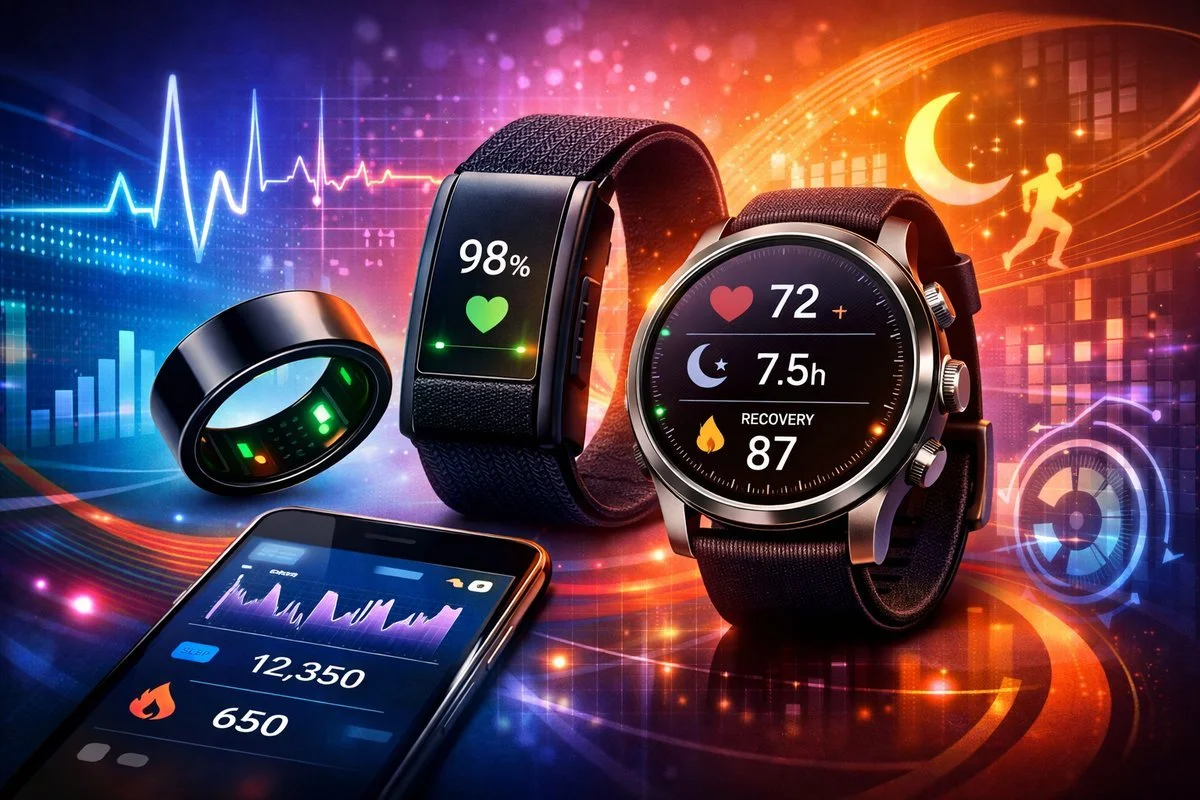
Wearable health trackers have moved from niche gadgets to daily companions. As a nutrition coach and personal trainer, I’m someone who operates on data. I want to know how my heart rate fluctuates during a workout, whether last night’s sleep was restorative and even how my body responds to stress.
Over the past few years my personal wearable journey has centered on the Oura ring, which I wear day and night. I haven’t personally strapped on a Whoop, Garmin or Apple Watch, but we’re going to dive into them to compare and contrast wearables.
In this post I’ll share my experience with Oura, summarize what the research says about the rest, and help you decide which device might be best for you.
Let’s get into it.
Why track your health?
Before diving into the devices, let’s talk about why you might track your health in the first place. Continuous monitoring lets us spot patterns that one‑off doctor visits can’t capture. Resting heart rate and heart‑rate variability (HRV) provide insights into cardiovascular health and readiness to train. Sleep quality influences recovery, cognition and immune function. Peer‑reviewed studies show that wearable devices can bridge the gap between clinical diagnostics and daily life.
For example, a systematic review of the Oura ring concluded that the device’s sleep metrics have comparable accuracy to polysomnography and actigraphy for commonly measured parameters. Another cross‑device study found that Oura’s Generation 3 and 4 rings provided the highest accuracy for resting heart rate and HRV, whereas Whoop showed moderate accuracy and Garmin even lower concordance.
These devices aren’t replacements for medical tests, but they can offer valuable adjunct information and encourage healthier habits.
Living with the Oura Ring
Full disclosure, I' personally wear the Oura ring. The ring form factor is discreet – I often forget it’s there until my dashboard lights up with metrics. Oura’s sensors sit snugly against the arteries in your finger, providing stable photoplethysmography (PPG) readings. The company’s technical white paper notes that Oura monitors more than 40 validated health metrics, including heart rate, HRV, body temperature and respiratory rate, using infrared LEDs and thermistors. It stores up to a week of data and the battery lasts up to eight days, so I don’t have to charge it nightly.
Women’s Health and Illness Detection
One of Oura’s standout features is its partnership with Natural Cycles for birth control and fertility awareness. The ring’s temperature sensors and menstrual‑cycle algorithms can predict fertile windows and upcoming periods – a feature that many women appreciate. Oura also tracks temperature deviations and HRV changes to provide early illness alerts. For chronic disease management, continuous monitoring may allow physicians to detect trends before symptoms arise.
Pros and Cons
Pros: Discreet design; long battery life; top‑tier accuracy for resting HR and HRV; robust sleep and readiness metrics; women’s health and illness detection; compatibility with both iOS and Android.
Cons: Requires a monthly membership to access full insights (although it’s quite minimal), no display (you must check the app), and price can be high for a ring.
A Note on Training Without Wearables
Although I rely on the Oura ring for sleep and recovery insights, I usually take it off when I train. I prefer the freedom of moving without a ring, strap or watch on my wrist or finger during workouts. This habit may influence how I perceive wearable sensors, but it also means I focus my data collection on recovery rather than real‑time training metrics.
Whoop: What the research says
Although I haven’t personally worn a Whoop strap, research suggests it is popular among athletes who want a recovery‑focused tracker with coaching features. Whoop is a wrist‑worn strap with no screen. Its minimalist design forces you to engage with the mobile app for data. The strap continuously measures HR and HRV, and its “strain” score estimates the cardiovascular load of your day.
According to an independent study funded by the Australian Institute of Sport and conducted by Central Queensland University, Whoop achieved 99.7 % accuracy in measuring heart rate and 99 % accuracy in measuring heart‑rate variability. The same research found that Whoop outperformed other consumer devices in total sleep time detection.
Sleep and Recovery Metrics
Whoop’s sleep algorithm uses photoplethysmography and accelerometry to detect sleep and wakefulness. It provides personalised sleep need recommendations based on your recent strain and recovery. Reviews suggest its sleep staging isn’t as granular as Oura’s, but the recovery score – built from HRV, resting heart rate and respiratory rate – closely mirrors how people feel. Whoop also reports variability in HRV (HRV‑CV) and provides breathwork sessions to improve parasympathetic tone.
Athletic Coaching and Community
Whoop emphasises coaching. Its app offers group challenges, live heart‑rate sharing and integration with training platforms. The company recently added a “Whoop MG” model with blood pressure and atrial fibrillation detection, but at the time of writing these features are only available in select markets. Keep in mind that in cross‑device validation, Whoop’s accuracy for resting heart rate and HRV was rated moderate (CCC ≈ 0.91 and 0.94) and not as precise as Oura.
Pros and Cons
Pros: High HR and HRV accuracy in independent studies; recovery‑focused metrics; strain score helps athletes pace training; robust community features; comfortable strap.
Cons: No display; requires a monthly subscription; moderate accuracy for resting HR and HRV compared with Oura; strap can get sweaty; fewer lifestyle features (no GPS or notifications).
Apple Watch: The Multifunctional Powerhouse
Apple’s smartwatch is the Swiss Army knife of wearables. Although I haven’t personally worn one (nor will I), I’ve evaluated it for people who want an all‑in‑one device. The Series 11, released in 2025, introduced sleep score and hypertension notifications alongside existing features like ECG, blood‑oxygen monitoring, fall detection and menstrual‑cycle tracking.
Apple’s press release states that the Series 11 offers notifications for signs of chronic high blood pressure plus a sleep score, extending its health suite, and provides up to 24 hours of battery life in a thin and comfortable design. The watch face uses Ion‑X glass that is two‑times more scratch resistant, and watchOS 26 adds features like Workout Buddy, wrist‑flick gestures and 5G cellular.
Health monitoring
Apple Watch includes an ECG app approved by regulatory bodies to detect atrial fibrillation. It monitors blood oxygen saturation, tracks sleep stages and provides retrospective ovulation estimates. The new hypertension notifications use the optical heart sensor to analyse how blood vessels respond to each heartbeat; the algorithm reviews data over 30‑day periods and alerts users if it detects consistent signs of high blood pressure. Like other Apple health features, these notifications are grounded in machine‑learning models trained on data from over 100,000 participants and validated in clinical studies.
Lifestyle and Convenience
Beyond health, Apple Watch is a mini‑computer on your wrist. It handles calls, texts and music streaming; integrates with Apple Fitness +; and offers contactless payments. With 5G connectivity, you can leave your phone at home. Users appreciate being able to glance at their watch to see heart rate during workouts and to track pacing. In the Kygo Health analysis, Apple Watch ranked highest for active heart‑rate accuracy (mean absolute percentage error 13.7 %) and second for step count accuracy, making it a solid choice for general fitness tracking.
Pros and Cons
Pros: Comprehensive health suite (ECG, SpO₂, hypertension alerts, sleep score); accurate active heart‑rate and step tracking; integration with iPhone ecosystem; 5G connectivity; no subscription required for core features.
Cons: Battery life limited to ~24 hours, requiring daily charging; bulkier than a ring; high price; relies on iPhone (Android users need not apply).
Choosing the right tracker
So which wearable is best? It depends on your goals and your willingness to wear a ring, strap or watch.
If recovery and sleep are top priorities: The Oura ring provides the most accurate resting heart rate and HRV measurements and offers rich sleep insights with cycle and illness detection. It’s comfortable and discreet, but you’ll need a subscription and you must use the mobile app for feedback.
If you’re a competitive athlete: Whoop’s strain and recovery scores help optimise training. Independent research shows its HR and HRV accuracy rivals medical‑grade equipment, and the community features can be motivating. Just remember there’s no display and membership is required.
If you’re a runner or triathlete: Garmin watches provide best‑in‑class GPS, VO₂ max estimates and Body Battery energy tracking. Their sensors are less accurate for resting HR/HRV, but you can pair a chest strap for more precision. There’s no subscription, which saves money long‑term.
If you want an all‑in‑one device: Apple Watch delivers a broad health suite, high active heart‑rate and step accuracy, plus the convenience of notifications and workouts. Battery life is shorter and it’s tied to the Apple ecosystem, but for many the versatility is worth it.
Final thoughts
Wearable technology has matured into a legitimate tool for health and performance. The devices discussed here are not medical devices, but peer‑reviewed research shows they can approximate clinical measurements and promote healthier behaviours. Personally, I’ll keep wearing my Oura ring – it fits my lifestyle and gives me the metrics I care about.
Even so, I stay curious about Whoop, Garmin and Apple Watch because different people have different needs. Ultimately, choose the tracker that aligns with your goals and preferences, and remember that the data should support, not dictate, your wellness journey.